
How AI agents actually work in customer support, without the hype
Not a magic chatbot, not a full replacement for your team — a mechanical look at what an AI agent actually does between a customer's message and a resolved conversation.
 The Samvaads teamMar 4, 20262 min read
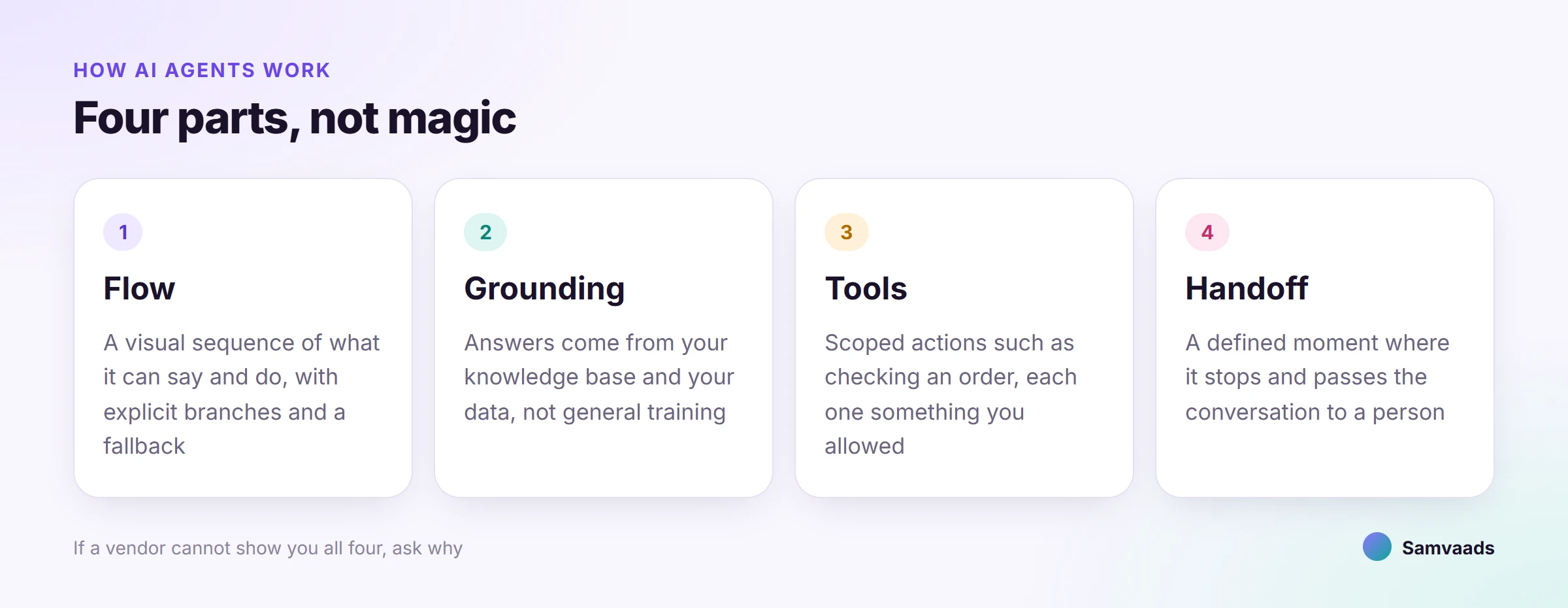
Strip away the marketing, and an AI agent in customer support is a fairly mechanical thing: a flow, a set of tools it is allowed to use, a knowledge base it is grounded in, and a rule for when to hand off. Understanding those four pieces is more useful for evaluating one than anything a demo video will show you.
The flow
An AI agent is built on a defined flow — a visual sequence of what it can say and do, not an open-ended instruction to "handle customer support." A well-built agent has explicit branches for the cases it is designed to handle, and an explicit fallback for everything else. If a vendor cannot show you the flow, that is worth asking about.
The grounding
A responsible AI agent answers from your knowledge base and your data — order status, account details, documented policy — not from the model's general training. This is the difference between an agent that says "your order ships in 3-5 business days" because that is your actual policy, and one that says it because it is a plausible-sounding sentence about shipping in general.
The tools
To do anything beyond answering questions — checking an order status, triggering a refund, updating a subscription — an AI agent needs tools: defined actions it is allowed to call, usually through an internal API, external API, or MCP connection. Scoping those tools tightly is most of what makes an agent safe to deploy: an agent that can only look up an order is a very different risk than one that can also issue refunds.
The handoff
Every well-designed AI agent has a defined moment where it stops and hands off to a human — low confidence, an angry customer, a request outside its scope — and that handoff should carry a summary, not drop the customer back to square one. An agent without a real handoff path is not actually finished; it is just going to fail conversations silently instead of gracefully.
What this looks like in Samvaads
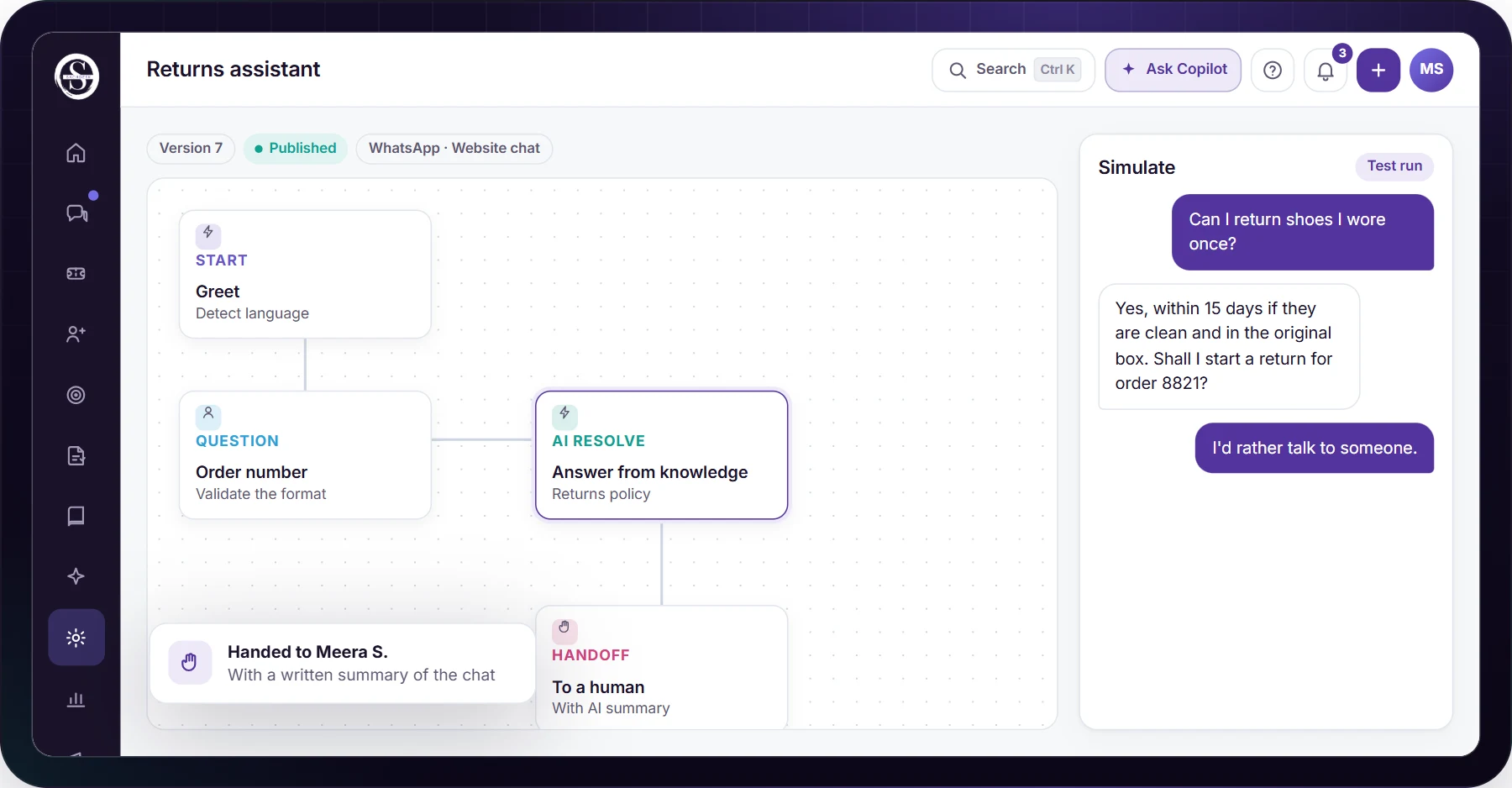
AI agents in Samvaads are built on a visual canvas, grounded in your knowledge base, simulated before publish, and always include a handoff step that carries context to the human who takes over.
See it running in Samvaads
Everything described here is a real, shipping part of the product, not a roadmap item.